


01 · SAFFRON
Three red threads. One flower.
Picked by hand.
A clear, honest look at how saffron is grown in a controlled room: what it takes, what it costs you in time and care, and whether it is right for you. Taught by people who grow it every season.
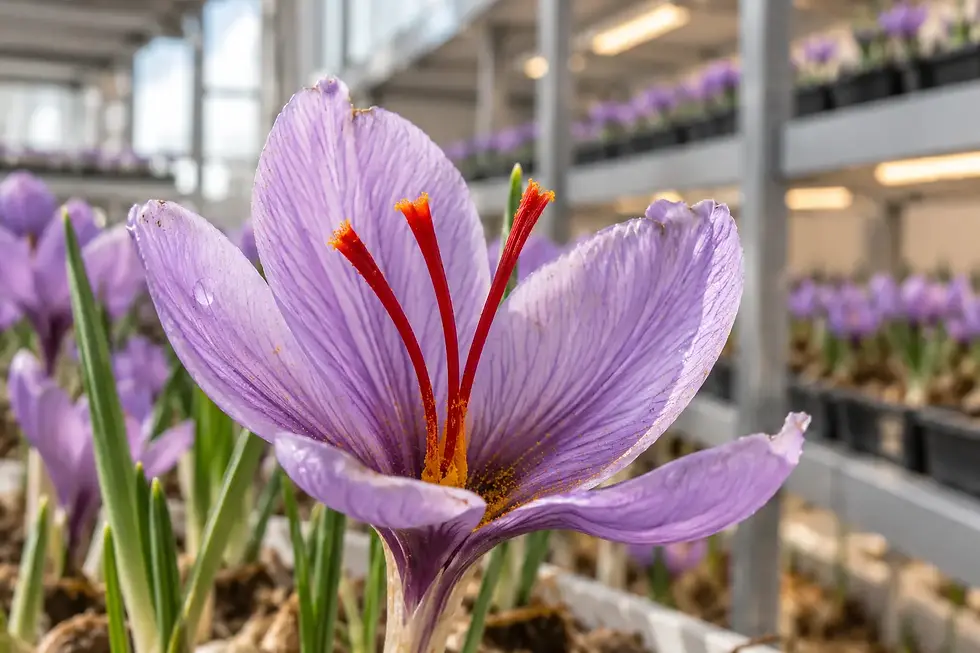
Saffron is the dried stigma of Crocus sativus, a small purple flower that blooms for only a few weeks each year. Each flower carries just three red threads, and each one is picked and separated by hand. It takes around one and a half lakh flowers to make a single kilo.
That is why saffron is the most valuable spice in the world, and why its quality matters so much. In India, demand is far greater than what Kashmir can grow, and much of what we use is imported.
Growing it indoors changes the equation. The climate that Kashmir offers for a few weeks can be recreated in a room, anywhere, with the right knowledge.
Indoor saffron at a glance
Max 3
harvests a year in a controlled chamber
1
flower from each corm, every bloom
Up to 3
red stigmas in every flower. This is the saffron.
Up to 7
×
corm multiplication, so your seed stock grows each season
WHAT ONE CORM CAN DO
02 · TYPES OF SAFFRON
Not all saffron is the same.
TYPE
Kashmiri Mongra
INDIA · GI TAGGED
Kashmiri Lachha
INDIA
Iranian Negin & Sargol
IRAN
Spanish La Mancha
SPAIN · PDO
Saffron is graded worldwide under ISO 3632, which measures colour(crocin), taste (picrocrocin) and aroma (safranal) in a laboratory. Grade I is the highest.
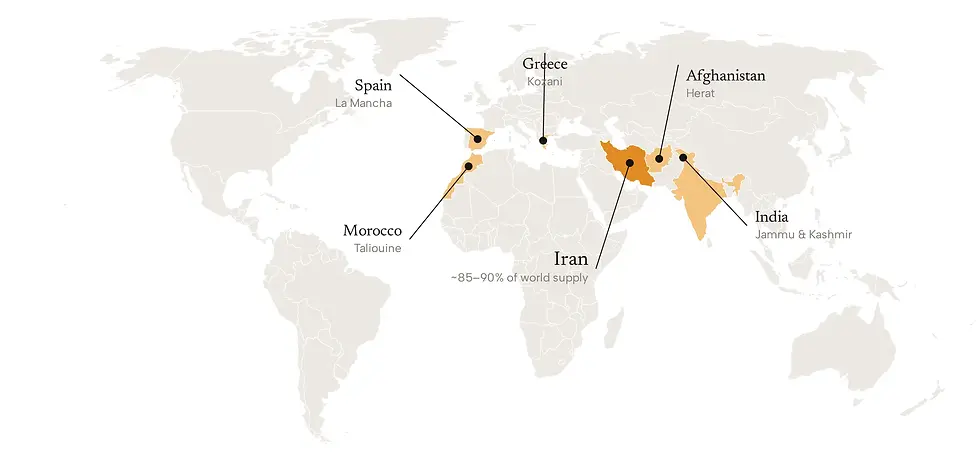
Where the world’s saffron grows
~9 in 10
kilos of the world’s saffron come from Iran.
Largest producer
WHAT IT LOOKS LIKE
Only the deep crimson tops of the stigma. Thick, dark threads.
Whole stigma with some of the yellow style attached.
Negin: long, thick, all-red threads. Sargol: red tips only.
Red threads, carefully toasted during drying.
Other producers
~100 t
India’s yearly demand, while Kashmir harvests only around 20 tonnes.
Origin, grade and how the threads are cut decide colour, aroma and price. Knowing the difference is the first step to growing, and selling, the right kind.
HOW QUALITY IS GRADED · ISO 3632
Category I
Category II
Category III
Minimum colouring strength (crocin). Higher is better.
KNOWN FOR
Strong colour and aroma. The premium Indian grade.
A more affordable Kashmiri grade for everyday use.
Most of the world’s supply. Consistent colour, widely traded.
A distinct, slightly smoky aroma. Prized in European cooking.
MAIN PRODUCING COUNTRIES
≥ 190
≥ 150
≥ 110

03 · HOW IT GROWS INDOORS
A year in the life of a saffron corm.

Saffron doesn’t grow from seed. It grows from corms, small bulbs that flower once and then multiply. Every stage needs its own conditions, and that is where most beginners go wrong.
04 · Stage by stage
From corm to harvest, step by step

Stage 1 · Corms
Choosing the corm
Size, weight and health decide how many flowers a corm will give. The season is won or lost here.

Stage 2 · Treatment
Cleaning & treating
Corms are cleaned, graded and treated to prevent rot and fungus before they go into the chamber.

STAGE 5 · HARVEST
Picking & drying
Flowers are picked early, stigmas separated the same day, then dried gently to lock in colour and aroma.
What happens at each stage of an indoor season, and what you need to get right.

Stage 3 · Dormancy
Rest, then the cold shock
Corms rest in warmth, then a controlled drop in temperature tells them it is autumn, and time to flower.

STAGE 6 · MULTIPLICATION
Next season’s corms
After flowering, corms are planted to multiply. A good season gives you more corms than you started with.

STAGE 4 · FLOWERING
The bloom
For a few weeks, flowers open on the racks every morning. Climate, light and air have to stay steady.
05 · INSIDE OUR FACILITY
Real rooms.
Real flowers. Nothing rendered.
Everything we teach comes from chambers we run ourselves. This is what that looks like.


Door opens, full view of racks in bloom.
Separating stigmas at a table.

Red threads spread on a drying tray.

Rows of trays with flowers, grow lights on.

Graded saffron in its jar.
06 · TECHNOLOGY
The climate of Kashmir, held steady in a room.
CLIMATE
Temperature & humidity
Held within a narrow band, with a separate recipe for each stage, from dormancy to bloom.
Engineered by Precite.ai. The automation in our chambers is built by Precite.ai, drawing on four decades of industrial refrigeration and climate-control experience.

Monitoring dashboard.
AIR
Fresh air & CO₂
Controlled air exchange keeps the room fresh and helps prevent fungus and rot.
Saffron is unforgiving. A few hot hours or a spike in humidity at the wrong time can cost a season. Our chambers use automation so the conditions stay right, day and night, whether or not someone is in the room.
LIGHT
Grow lighting
Lighting tuned for saffron, on a fixed daily cycle that mimics the season outside.

MONITORING
Sensors & alerts
Every reading is logged. If anything drifts, the grower gets an alert on their phone.
Control panel.

07 · FROM FLOWER TO MARKET
Growing is half the work. The rest decides the price.
Once harvested, saffron has to be dried, graded, tested, packed and labelled correctly before anyone will pay a fair price for it. Buyers want proof of purity and a grade they can trust.
We cover how saffron is processed, how laboratory grading works, what licences you need to sell food products in India, and who actually buys saffron, from local retail to bulk buyers.
08 · WHAT YOU MAY HAVE HEARD
A few things worth correcting.
YOU MAY HAVE HEARD
One room will make you rich in a season.
Yield depends on corm quality, climate discipline and experience. Treat the first season as a serious learning season.
YOU MAY HAVE HEARD
Any air-conditioned room will do.
Cooling is only one part. Humidity, fresh air, light and a controlled cold shock all matter just as much.
There is a lot of noise online about saffron. We would rather you start with the truth.
YOU MAY HAVE HEARD
Saffron grows from seeds.
It doesn’t. Saffron is sterile and grows only from corms, which multiply underground each year.
YOU MAY HAVE HEARD
Selling saffron is the easy part.
Buyers pay for tested, graded, well-packed saffron. Ungraded saffron is hard to sell at a good price.

Ankit Sharma
09 · Your mentor
Lead mentor · Operations & Quality
“You don’t learn saffron from a video. You learn it in the chamber, one season at a time.”
Ankit works with modern farming systems and agricultural market operations. He leads R&D and cultivation optimisation on our farm, with a focus on what actually scales commercially, from corm selection and climate recipes to grading and selling the harvest.
He holds a B.Sc. (Hons.) in Agriculture and an MBA in Sales & Marketing, and has trained growers across India.
8+
100+
All season
years growing saffron indoors
trainings conducted
growing, not just the autumn weeks
One mentor, start to finish. The person who teaches you is the person who answers your questions after.
The introductory webinar
Ninety minutes
to understand it all, before you invest in anything.
Topic 01
Topic 02
Topic 03
Topic 04
Topic 05
Topic 06
Topic 07
Introduction to saffron
Types & grades
Growing indoors
Equipment & technology
Harvest to packet
Markets & planning
Your questions
A 90-minute live session that walks through everything on this page in depth, with real footage from the chamber and time for your questions. Built for complete beginners.
What saffron is, why it is so valuable, and India’s supply gap.
Kashmiri, Iranian and Spanish saffron, grading, and how to spot adulteration.
Corms, treatment, sowing, dormancy, the cold shock and flowering.
What goes into a chamber, and a live look at the monitoring dashboard.
Harvesting, processing, packaging, labelling and certification.
Who buys saffron, realistic expectations, and how to plan your start.
Open Q&A in Hindi or English.
JOIN THE SESSION
If you have read this far, the webinar is for you.
You don’t need land, a farming background or any technical knowledge. The session is taught live in Hindi and English, with time set aside for your own questions.
Live, 90 minutes on Zoom or Google Meet
Live chamber walkthrough, not pre-recorded slides
Direct Q&A with the mentor about your space, city and budget
Fee credited in full if you join the Advanced Program